8 min read
▶ Listen to this story · 8 min 44 sec
Read by an AI voice.
A new design for prosumers, light industrial work and office production.
In November 2025, Bambu Lab launched the H2C with its Vortek hotend change system: a rack of spare hotends that the printer swaps onto the right side of its print head.
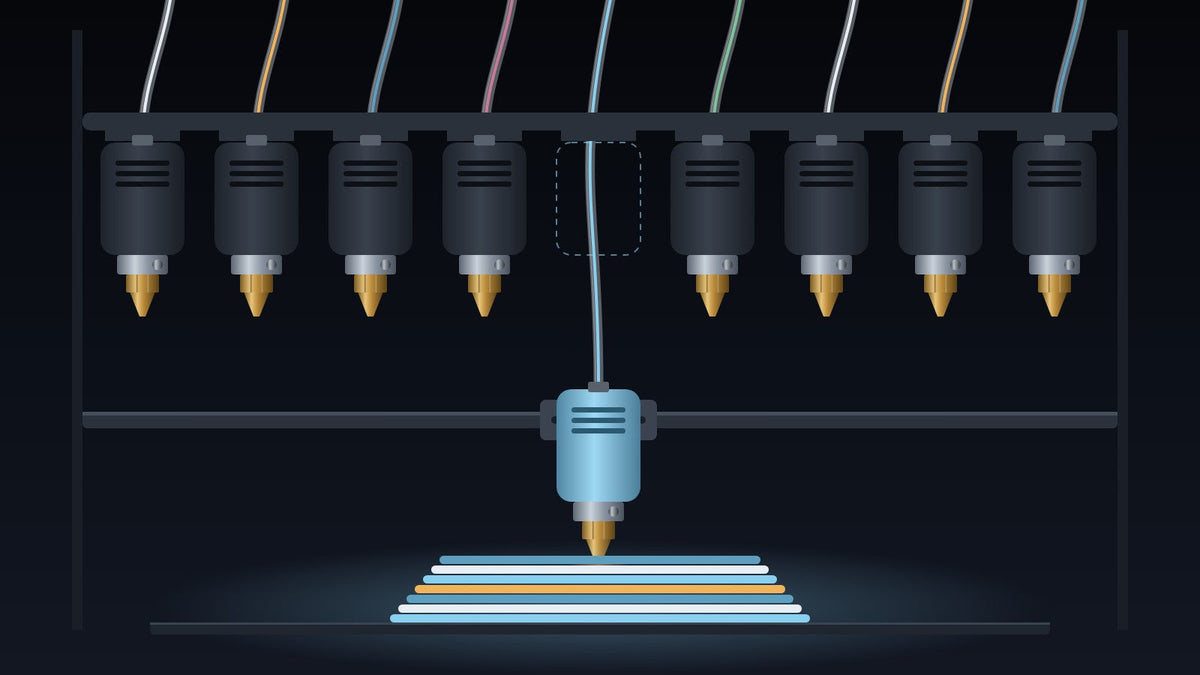
On November 3, 2026, Bambu Lab launched a printer that takes a different path. It is called the H3C. Instead of swapping hotends onto one print head, it switches between nine complete print tools, each with its own heater and nozzle.
What Bambu Lab announced
Bambu Lab calls the H3C its first third-generation printer. The nine tools wait on a rack, and the printer picks up the one it needs. The company says a change takes under six seconds, because the waiting tool is already loaded and can be warmed up ahead of time.
- Price: $2,499 before tax in the US, including its nine-spool filament box, the AMS 3H. Bundles cost $2,589 (with PLA and TPU filament), $2,799 (adding the open Bambu Station stand) and $3,049 (adding the enclosed Station and an E1 air purifier).
- Build size: 330 × 320 × 325 mm, about 13 × 12.6 × 12.8 inches.
- Heat: up to 350°C at each nozzle, 120°C at the bed, and chamber heating up to 65°C.
- Filament box: sealed, holds nine spools, and can dry two of them at up to 85°C, even while printing. It reads the tag on Bambu Lab's own spools to know the material. Spools from other brands have to be set up by hand, and the two drying spots do not read tags.
- Materials: PLA, PETG, TPU, ABS, ASA, nylon, polycarbonate and fiber-filled versions, among others.
Bambu Lab also says prints finish on average more than 10% faster than on its previous flagship. It did not say how that was tested.
There was news for current owners, too. Bambu Lab says software updates will let the H2D, H2C and X2D print a single part with various nozzle sizes: the H2D in November 2026 (February 2027 with a filament track switch), and the H2C and X2D in February 2027 (March 2027 with the switch).
What the reviewers liked
Bambu Lab sent early printers to well-known 3D printing reviewers, who published their verdicts on launch day. Most of them were very positive. Several called it the best or most capable printer they have used, and one called the price "incredibly aggressive" for everything the machine combines.
Tool changes really are fast. Reviewers measured about six to seven seconds per change, against half a minute or more on the H2C.
Multicolor jobs finish much sooner. In side-by-side tests, a seven-color print took 28 hours on the H3C, against an estimated 62 hours on the H2C. A nine-color model took 15 hours 12 minutes, against 24 hours 44 minutes for a five-color version on the H2C. On everyday single-color prints, one reviewer found it only about 10% faster than the H2C or H2D.
Very soft and mixed materials. One of the nine tools takes thicker 2.85 mm filament, which makes very soft rubber-like TPU much easier to print. Reviewers printed comfortable shoes, and one mixed different filament brands in the same print without trouble.
Print quality. Reviewers described print quality as excellent, with clean color changes. One ran it for almost 400 hours.
What the reviewers did not like
It is tall. With the filament box on top, it stands nearly 50 inches high with the lid open. Reviewers needed a step stool or a small ladder to reach the back spools. One recommends a low table about the height of a coffee table; another recommends Bambu Lab's own stand. One also warned that the power cable is barely long enough, so plan where the outlet is.
Only two of the nine spools can be dried. This was one of the most common complaints. If you dry filament often, you will be moving spools around, or drying them outside the printer.
No automatic rewinding. The filament box does not pull filament back. You unload it by hand, and you have to remember to unload PLA before printing hot materials such as nylon.
Less waste, not zero waste. Each tool change still purges a little plastic into a tower beside the print. One reviewer measured about 50 milligrams per change, which added up to almost 200 grams on one large print. Another printer with tool changers, Prusa's INDX, purged about one-fifth as much in one reviewer's test.
Early software rough edges. Reviewers tested on pre-release software, and several hit problems:
- A tool came loose during long prints. One reviewer found the tools must be pushed straight into the rack, not hooked in at an angle, or they can fall out mid-print.
- Automatic nozzle calibration sometimes skipped a needed recalibration. Setting it to "on" fixed it.
- A slicer bug, which Bambu Lab said will be fixed in the final release.
- A failed sensor on one early unit, and filament-detection problems on another that firmware updates fixed.
Other complaints. No Ethernet port, only Wi-Fi. Parked tools can be hot enough to burn a finger. The filter does not fully remove the smell of ABS or ASA. One reviewer said "that learning curve is steep," and firmware updates plus a full calibration took about an hour.
The cloud question
The H3C is a cloud-connected printer. One reviewer likes that: settings sync across computers, prints can be started and watched from anywhere, and the software keeps improving. Another called it a "walled garden" that won't suit everyone. One reviewer also said he still has concerns about how Bambu Lab handles open source and treats some community members.
You can print without the internet: reviewers mention USB, the printer's own storage and a local-network-only mode. For businesses that must keep printers on a closed network, Bambu Lab offers a product called Fleet Hub.
Why it matters
For makers and small shops that mix colors and materials, the H3C brings nine tools, very soft flexibles, hot engineering plastics and various nozzle sizes together in one print. One reviewer said no other printer on the market right now can match what it brings. That is a real step forward for desktop printing.
It is not for everyone. If you mostly print one or two colors of PLA or PETG, cheaper printers do that well. And a printer this new is still being tuned.
If you already own an H2D, H2C or X2D, Bambu Lab's update for various nozzle sizes is coming to your machine, so it may be worth waiting to see what that brings before you replace it.
What you can do
- Price the whole setup: a stand or low table, spare tools ($59 each), filament and air filtering.
- Measure the height where it will live, and check that an outlet is close behind it.
- If you dry filament often, plan for an outside dryer. Only two spots inside dry.
- If you print for paying customers, consider waiting for finished software and owner reviews.
- If you use filament from other brands, expect to set each spool up by hand.
- Ask Bambu Lab in writing what works without an account and without the internet before you buy.
The question to ask
What will this printer really cost me, and what does it need from the company to keep working?
From the publisher
KRUDO Designs uses Bambu Lab and Elegoo printers to prototype its designs. Bambu Lab did not pay for, see or approve this story. Several of the reviewers quoted here received their printers from Bambu Lab, and several earn commissions from links in their reviews.
Sources
- Bambu Lab, H3C launch announcement, Nov 3, 2026
- Bambu Lab, update for H2D, H2C and X2D, Nov 3, 2026
- Bambu Lab Store, AMS RFID board
- Tom's Hardware, H2C launch, Nov 18, 2025
- Tom's Hardware, H3C review, Nov 3, 2026
- CNC Kitchen, H3C review, Nov 3, 2026
- How-To Geek, H3C review, Nov 3, 2026
- TechRadar, H3C review, Nov 3, 2026
- FauxHammer, H3C review, Nov 3, 2026
- Clough42 (YouTube), H3C review, Nov 3, 2026
- Uncle Jessy (YouTube), H3C review, Nov 3, 2026
- 3D Printing Industry, Nov 3, 2026
This article is based on the published reports listed above, written in our own words. Details are as reported on the dates shown. Spotted an error? Email support@krudodesigns.net and we will correct it.